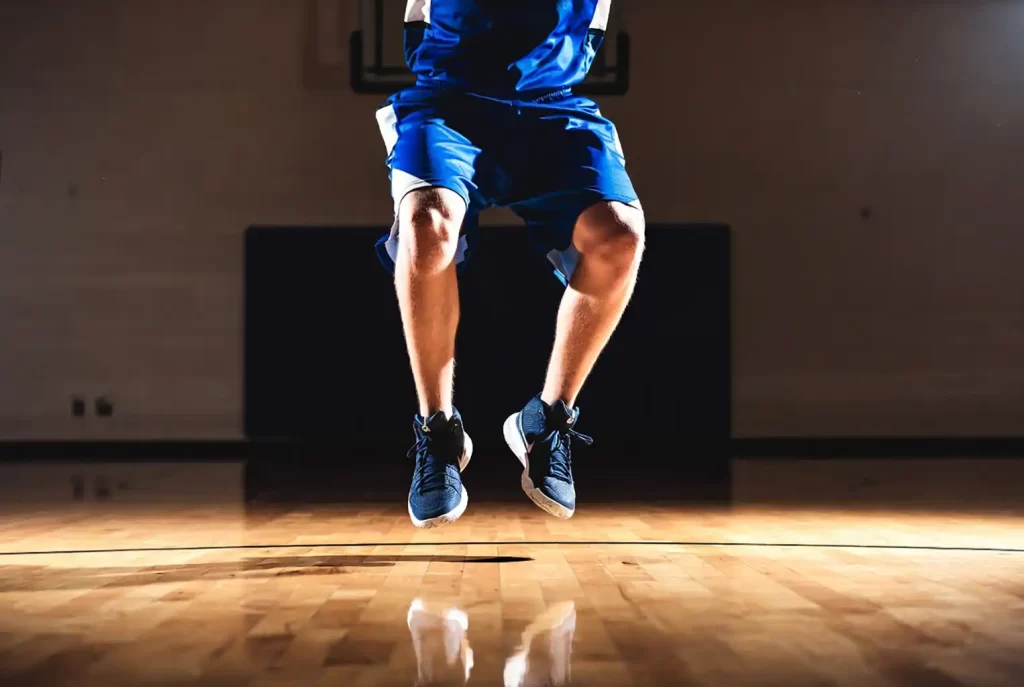
Basketball is a jumping sport. Every time you come down from a rebound, a layup, a contested shot, or a defensive block, your body has a fraction of a second to absorb force that can reach six to eight times your body weight. Do it well, and you keep playing. Do it poorly — even once — and you can end up on the sideline for a season or longer.
Most non-contact knee injuries in high school basketball happen during landing. Not during jumping, not during sprinting, and not during contact — during the split second when your feet hit the floor and your body has to decelerate. The good news: safe landing is a learnable skill.
This guide breaks down the four mechanical pillars of a safe landing, the five mistakes that put players on the sideline, and the exact drills that rewire your body to land safely at game speed.
01 Why Landing Mechanics Matter More Than Jumping
Athletes spend thousands of hours working on vertical leap, explosive first step, and jumping power. Very few spend any time at all on how they come down. That's a mistake.
Research consistently shows that the way a player lands is one of the single biggest predictors of whether they'll tear an ACL, develop patellar tendinopathy, or sprain an ankle. Landing is where force meets tissue — and where alignment determines whether that force gets distributed across strong, redundant structures or absorbed by a single vulnerable ligament.
Three realities every serious player needs to accept:
- You cannot train landing technique after you're already airborne
- Good landings are built on the practice court, not discovered in games
- Fatigue breaks mechanics — late-game landings are when injuries happen
HSBP Pre-Habilitation Insight
A player who lands cleanly on film looks more athletically mature to college coaches — even before the first point is scored. Movement quality is visible on highlight reels. Coaches evaluate durability as much as talent, and safe landing mechanics are one of the clearest signals that a player has done the work.
02 Pillar 1 — Forefoot Loading
The first point of contact on every landing should be the balls of your feet — not your heels, not flat-footed. Landing forefoot-first engages the calf complex (gastrocnemius, soleus, and Achilles tendon), which acts as your body's primary shock absorber. From there, the heel lowers briefly to the floor as the ankle, knee, and hip flex in sequence to dissipate force.
What Bad Forefoot Loading Looks Like
- Heel-first contact — force transmits straight up through the shin, knee, and hip with no absorption
- Flat-footed slap landings — lock up the ankle and pass all force to the knee
- Rolling to the outside edge of the foot — classic ankle-sprain position
What Proper Forefoot Loading Looks Like
- Balls of feet touch first, then heels kiss the floor a fraction of a second later
- Ankle actively plantar-flexes on contact — calves engage to absorb
- Feet parallel and shoulder-width apart at touchdown
- Weight centered over the middle of the foot, not rolled to one side
Training Drill — Silent Pogo Jumps
- Stand tall, feet shoulder-width, arms relaxed
- Hop 4–6 inches off the ground using only your calves — no knee bend
- Focus on landing silently on the balls of your feet
- Loud landings mean you're collapsing into the floor, not absorbing
- 3 sets · 20 reps · daily during pre-season
03 Pillar 2 — Knee Alignment
This is the most important alignment rule in all of basketball injury prevention: your knees must track directly over your toes on every landing. When the knees collapse inward — a pattern called knee valgus or "knock-knees" — the ACL is placed in an extremely vulnerable position. The vast majority of non-contact ACL tears happen in exactly this position.
What Causes Knee Valgus on Landing
- Weak glute medius and hip external rotators
- Tight hip flexors from long hours sitting
- Poor foot mechanics — flat feet or excessive pronation
- Fatigue — mechanics degrade late in games
- Lack of conscious cueing during practice landings
The Self-Check Protocol
Film yourself from the front landing from a 12-inch box drop. Play it back in slow motion and look at your knees at the exact moment of touchdown. If they cave toward each other — even slightly — you have a valgus pattern that needs correcting before you play another competitive minute.
Training Drill — Banded Box Drops
- Place a resistance band above your knees
- Step off a 12–18 inch box and land in athletic position
- The band actively pulls your knees inward — you must push outward against it
- This trains the glute medius to fire reflexively on every landing
- 3 sets · 8 reps · 3×/week
04 Pillar 3 — Hip Engagement
On a correct landing, the hips move backward and down — not forward over the toes. Think of sitting into an invisible chair behind you. This position loads the glutes and hamstrings, which are the massive, powerful muscles designed for exactly this kind of deceleration work.
When athletes land "knee-dominant" — with the knees pushing forward past the toes while the hips stay high — the quadriceps and patellar tendon take almost all of the force. That's a recipe for jumper's knee, patellar tendinopathy, and eventually ACL strain.
The Hip Hinge on Landing
- At the moment of touchdown, hips drive backward and down
- Chest stays tall — do not fold forward at the waist
- Knees bend naturally as hips lower, tracking over toes
- Glutes and hamstrings engage to absorb — not the quads alone
Training Drill — Wall Tap Squat
- Stand with your back 6 inches from a wall
- Squat down until your butt taps the wall — hips go back, not down
- Knees stay behind your toes the entire time
- This trains the hip-dominant loading pattern your landings need
- 3 sets · 12 reps · daily
Why Hip Engagement Wins
Your glutes and hamstrings are built to absorb massive force. Your patellar tendon is not. Teach your body to load the hips first and the knees become passengers, not shock absorbers. This one habit alone reduces patellar tendinopathy and ACL risk more than any other single change.
05 Pillar 4 — Shock Absorption
A safe landing is a quiet landing. If you can hear your feet slap the floor from across the gym, you're landing stiff — transmitting force instead of absorbing it. Good landings look almost silent and feel springy, with simultaneous flexion at the ankle, knee, and hip.
The cue is "land like a cat." Ankles, knees, and hips all bend at the same moment, spreading the absorption across every joint in the chain. Stiff landings concentrate force into one or two joints. Soft landings spread it across five.
The Three-Joint Sequence
- Ankle — plantar-flexes on contact, calf engages
- Knee — bends 30–45° immediately on touchdown
- Hip — hinges back and down, loading glutes and hamstrings
- All three joints flex simultaneously — not sequentially
Training Drill — Depth Drop with 3-Second Hold
- Step (don't jump) off a 12–18 inch box
- Land in perfect athletic stance — forefoot, knees over toes, hips back
- Hold the landing for 3 full seconds without wobbling or correcting
- If you can't hold it, the rep doesn't count — quality over volume
- 3 sets · 6 reps · 3×/week
06 Five Landing Mistakes That End Seasons
Once you know what a good landing looks like, bad landings become obvious. Watch any youth basketball practice and you'll see most of these patterns happening dozens of times per hour — usually without any coach correcting them. Here are the five most dangerous:
Mistake 1 — Heel-First Contact
Sends impact straight up the skeleton with no muscular absorption. Over time, causes shin splints, stress fractures, and patellar pain. Fix: cue "toes first, heels kiss."
Mistake 2 — Knees Caving Inward (Valgus)
The single biggest ACL risk factor in basketball. Often invisible to the athlete themselves. Fix: strengthen glute medius, film from the front, cue "push knees apart."
Mistake 3 — Straight Legs on Impact
Locked knees can't absorb force — the ligaments do instead. Catastrophic injury risk. Fix: always land in athletic stance with soft knees bent 30–45°.
Mistake 4 — Uneven Foot Placement
Landing on one foot harder than the other doubles the load on that leg. Common after contested rebounds. Fix: two-footed landings when possible, drill single-leg landings with full hip engagement.
Mistake 5 — Forward Knee Dominance
Knees shooting past toes puts the patellar tendon and ACL under enormous shear stress. Fix: drill the hip hinge — "butt back, chest tall."
07 Your Weekly Landing Mechanics Routine
Fifteen focused minutes, three days per week, is enough to retrain your landing pattern over 4–6 weeks. Insert this block at the end of your dynamic warm-up, before any skill work or scrimmaging.
| Day | Focus | Key Drills | Time |
|---|---|---|---|
| Day 1 Mon/Tue |
Forefoot + Knee Alignment | Silent Pogo Jumps, Banded Box Drops, Depth Drop Holds | 15 min |
| Day 2 Wed/Thu |
Hip Engagement + Shock Absorption | Wall Tap Squats, Countermovement Jump with Stick, Depth Drops | 15 min |
| Day 3 Fri/Sat |
Full Protocol + Game Simulation | All drills at reduced volume, Single-Leg Landing Holds, Lateral Hop and Stick | 20 min |
Four to six weeks of consistent work will build new motor patterns. Twelve weeks will make them automatic — and automatic is the only thing that survives the chaos of a live game.
08 Red Flags — When to See a Professional
Pre-habilitation is proactive training, but it is not a substitute for medical evaluation when something is wrong. See a sports medicine doctor or physical therapist if you experience any of the following:
- Sharp pain during landing that doesn't resolve within a few days
- Persistent knee, ankle, or hip pain after practice that worsens over the week
- A popping, clicking, or grinding sensation during jumps or landings
- Instability — a feeling that the joint might give out on a landing
- Visible swelling that doesn't improve with rest and ice within 48 hours
- Any compensation pattern — favoring one leg, avoiding certain movements
The sooner a potential issue is identified, the better your outcome. Recruiting timelines can absorb a short break for proper diagnosis. They cannot absorb a torn ACL that went untreated because a player pushed through pain.
09 What College Coaches See on Film
Here's something most players don't know: college coaches watch how you move, not just whether you score. When a coach is evaluating a recruit, they're scanning for movement quality that signals physical preparation and durability.
- Does the player land cleanly, or are there obvious valgus patterns?
- Is there hesitation on landings after contested rebounds?
- Does the player favor one leg — a sign of compensating for old injury?
- Can they decelerate and change direction without wobbling or catching themselves?
Players who have done the landing mechanics work look different on film. More controlled. More athletic. More recruitable. Clean movement is invisible to the untrained eye — but college coaches notice immediately.
HSBP Platform Note
Your highlight video on HighSchoolBasketballPortal.com does the talking before you ever meet a coach. Every landing on film tells a story about how you've trained. Players who move cleanly project athletic maturity that separates them from equally-talented peers who haven't done the prehab work.
10 Quick Reference Cheat Sheet
Bookmark this. Review it before every workout.
Forefoot Loading
- Balls of feet first, heels second
- Silent landings — no floor slap
- Feet parallel, shoulder-width
- Silent Pogo Jumps · 3×20 daily
Knee Alignment
- Knees track directly over toes
- No inward collapse (valgus)
- Film from the front to self-check
- Banded Box Drops · 3×8 · 3×/wk
Hip Engagement
- Hips back and down, not forward
- Chest tall, hip hinge
- Glutes and hamstrings absorb
- Wall Tap Squats · 3×12 daily
Shock Absorption
- Ankle + knee + hip flex together
- Land like a cat — quiet and springy
- 30–45° knee bend at contact
- Depth Drop Holds · 3×6 · 3×/wk
11 The Bottom Line
A single bad landing can end a season. It can derail a recruitment. It can alter the trajectory of a career that took years to build.
The mechanics that lead to landing injuries are trainable. Forefoot loading is a skill. Knee alignment can be built. Hip engagement becomes automatic with repetition. Shock absorption improves with eccentric strength work. None of this requires expensive equipment or elite coaching — it requires consistency.
Players who invest in landing mechanics are not just protecting their health. They're investing in their ability to be seen, evaluated, and recruited. You cannot be on a coach's radar if you're on the sideline. And the difference between a player who stays healthy and one who doesn't is often a few weeks of deliberate work on exactly the mechanics in this guide.
Start with the drills. Three days a week. Fifteen minutes. Build the habit now, before the season demands everything you have.
You can't think your way through a safe landing at game speed.
You have to drill it until the nervous system owns it.
High School Basketball Portal · Free for All Players
Land Safely. Stay on the Court. Get Recruited.
HSBP is the only recruiting platform built with Pre-Habilitation as a core feature. Access landing mechanics drills, ACL protection programs, and mobility routines — free for all players.
Join Free Today