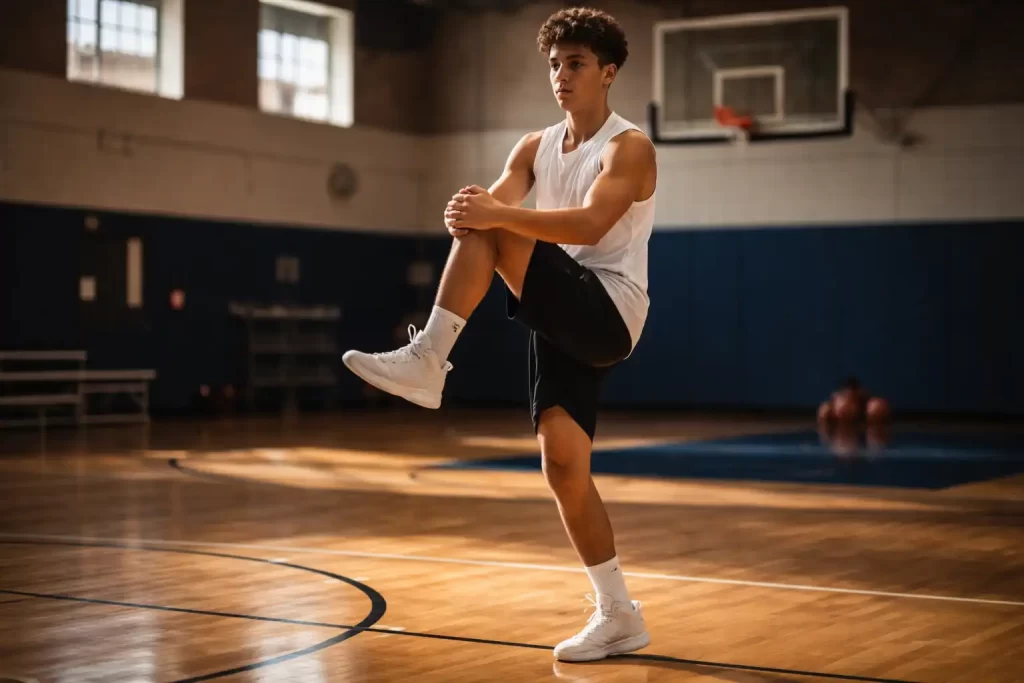
Every serious basketball player knows the feeling. A teammate plants to cut — then goes down grabbing a knee. A promising season over in a single step. What most players don't know is that injury could often have been prevented. That's the idea behind prehab training — one of the most powerful and most overlooked tools in a young athlete's development plan.
01 What Does "Pre-Hab" Actually Mean?
Pre-habilitation — commonly shortened to pre-hab — is a proactive approach to physical training that focuses on preventing injuries before they occur. The term is borrowed from the world of rehabilitation medicine, where "rehab" refers to recovering from an injury. Pre-hab flips that model entirely.
Instead of waiting for something to break down and then trying to fix it, pre-hab training builds the strength, mobility, and body mechanics that keep athletes healthy in the first place. Think of it as training your body to withstand the demands of the game — not just training to perform in it.
For high school basketball players specifically, basketball prehabilitation targets the areas of the body most vulnerable to the sport's unique physical demands: knees, ankles, hips, the Achilles tendon, and the entire posterior chain — the hamstrings, glutes, and lower back that act as the body's natural shock absorbers during explosive movement.
02 Pre-Hab vs. Rehab: What's the Difference?
The difference is simple but important.
Rehab (rehabilitation) happens after an injury. A player tears their ACL, undergoes surgery, and spends six to twelve months working with a physical therapist to rebuild strength, range of motion, and coordination. Rehab is necessary — but it is reactive. The damage has already been done.
Pre-hab (pre-habilitation) happens before any injury occurs. It is a structured approach to training that identifies and addresses physical weaknesses, movement imbalances, and flexibility limitations before they become injuries. Pre-hab is proactive. It gives athletes a fighting chance to stay on the court rather than spending months recovering on the sideline.
College programs and professional organizations have understood this distinction for years. Elite programs now invest heavily in pre-hab as a standard part of athlete development. For high school players, especially those hoping to compete at the next level, adopting this mindset early is one of the most important competitive advantages available.
03 Why Pre-Hab Matters Specifically for Basketball
Basketball is one of the most physically demanding sports on joints and connective tissue. Every game requires players to:
- Jump and land — repeatedly, on hard surfaces, often off-balance
- Accelerate and decelerate at full speed
- Cut, pivot, and change direction under pressure
- Compete for 20, 30, or 40 minutes without meaningful rest
These movements are beautiful when executed well. They are also precisely the movements that most frequently result in non-contact injuries — the kind where nothing external happens to the player. They simply plant, cut, or land in a way the body was not fully prepared to handle.
ACL tears. Patellar tendon inflammation. Achilles ruptures. Stress fractures. These injuries are devastating, and their rates among high school athletes have been climbing for years as players train year-round with increasing intensity and less structured recovery.
Prehab training for basketball directly addresses the physical conditions that lead to these injuries. It focuses on developing the supporting musculature — hamstrings, calves, glutes, and hip stabilizers — that protects the primary joints from absorbing dangerous levels of force. It also develops landing mechanics, flexibility, and body awareness that help athletes move safely at high speeds.
In short: the sport demands a lot from the body. Pre-hab prepares the body to meet those demands.
04 The Core Pillars of Pre-Hab Training
Effective injury prevention for athletes isn't a single exercise or a one-time routine. It is a consistent commitment to several interconnected training habits. For basketball players, the core pillars of pre-hab typically include:
Balanced Strength Development
Many training programs overemphasize visible, explosive muscle groups — particularly the quadriceps — because they produce impressive vertical leaps and powerful first steps. But strength imbalances create injury risk. A strong quad combined with an undertrained hamstring, weak calf, or underdeveloped glute means the knee joint absorbs forces it was never designed to handle alone. Pre-hab corrects these imbalances by building strength throughout the entire movement chain.
Mobility and Flexibility Work
Tight muscles and stiff joints move poorly under pressure. Dynamic warm-up routines before practice and structured stretching after sessions keep tissue elastic and joints moving through their full range of motion. For basketball players, hip flexor mobility, ankle flexibility, and hamstring length all have a direct relationship with injury risk.
Landing Mechanics and Movement Training
Many ACL injuries happen during landing — when a player comes down from a jump with a straight knee, a collapsed hip, or flat feet. Pre-hab training teaches athletes how to land softly: on the balls of the feet, with bent knees, engaged hips, and a neutral spine. These mechanics can be practiced and improved, and they dramatically reduce the forces that travel into the knee on every landing.
Recovery and Tissue Repair
Sleep, hydration, and intentional rest are not optional add-ons — they are essential components of any pre-hab program. Muscle tissue repairs and strengthens during recovery, not during training. Athletes who neglect sleep or chronically under-hydrate are progressively weakening their body's ability to handle the next session's demands.
05 Who Should Start Pre-Hab — and When?
Pre-hab is not reserved for injured athletes or those already experiencing pain. In fact, the athletes who benefit most from pre-hab are the ones who start before any problems appear.
Any high school basketball player who is serious about their development and their future in the sport should be incorporating pre-hab principles into their training — now. Not after the first injury. Not after the knee starts to ache. Now.
The earlier an athlete builds the movement habits, strength foundations, and mobility that pre-hab training develops, the more resilient their body becomes. And resilience is a competitive advantage. Coaches at every level notice which players stay healthy, show up consistently, and perform late in games — and late in seasons.
For players hoping to be recruited to play college basketball, durability is part of the evaluation. A player with the skill to compete at the next level who also demonstrates that they have prepared their body intelligently is a far more attractive recruit than one with equal skill and a history of preventable injuries.
Want to understand why young athletes are getting injured at record rates? Read Why Young Athletes Are Getting Injured More Than Ever — and How Pre-Habilitation Can Protect Their Future.
06 Pre-Hab Is a Mindset, Not Just a Workout
The most important shift a young basketball player can make isn't a new exercise. It's a new perspective.
Training to perform is important. Training to stay healthy enough to keep performing is essential. Basketball prehabilitation is what separates athletes who have long, productive careers from those whose potential gets cut short by injuries that could have been avoided.
The good news is that pre-hab doesn't require expensive equipment, a professional training staff, or a major time commitment. It requires consistency, intentionality, and the right knowledge about what the body needs to perform safely at a high level.
The articles ahead in this series will go deeper into each element of an effective pre-hab program — from the specific movements that protect the knee, to daily warm-up routines, to the role of sleep and nutrition in injury prevention. Start here. Build the foundation. Protect your career.
Training to perform is important.
Training to stay healthy enough to keep performing is essential.
High School Basketball Portal · Free for All Players
Build Your Foundation. Protect Your Career.
High School Basketball Portal is the only recruiting platform that combines player exposure with a dedicated Pre-Habilitation resource — free for every player.
Join Free Today