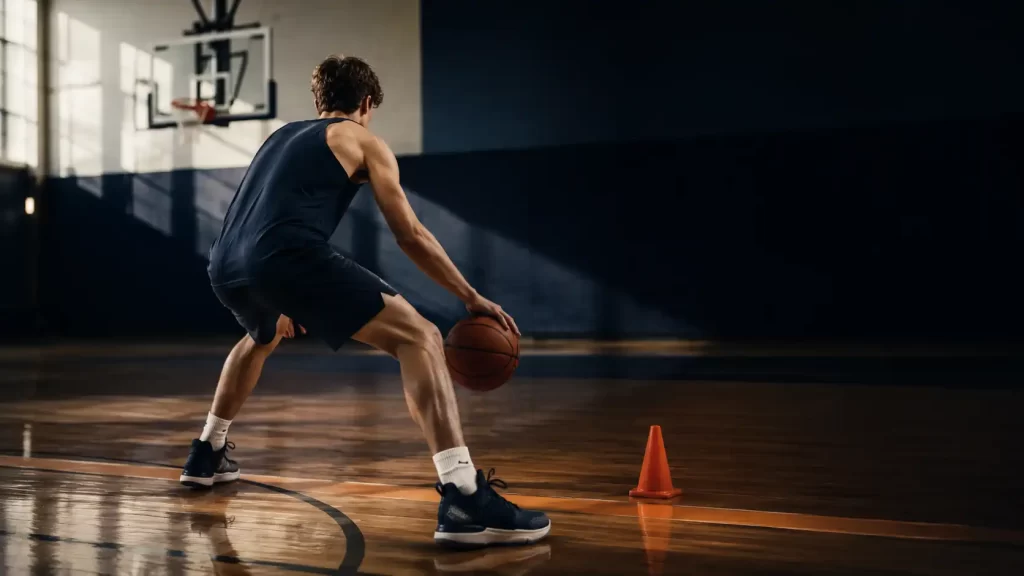
When the 2025–26 NBA season tipped off, the league announced a record 135 international players on opening-night rosters — athletes from 43 countries, with at least one on all 30 teams. The reigning MVP, Oklahoma City's Shai Gilgeous-Alexander, was born in Canada and just became the first back-to-back winner since Nikola Jokić. The last American to win the award was James Harden, in the 2017–18 season.
For the country that invented the game — Dr. James Naismith hung the first peach basket in Springfield, Massachusetts in 1891 — that is a remarkable shift. And it raises a question every American family with a young player should be asking: if the United States still has the most courts, the most leagues, and the most games, why is the rest of the world producing so many of basketball's best players?
The answer isn't talent.
It's development.
01 The Numbers Behind the Shift
The international wave is not a rounding error. A record 135 international players opened the 2025–26 season on NBA rosters — roughly one in three of the league's approximately 450 standard roster spots. Canada led all countries outside the U.S. with 23 players, followed by France (19) and Australia (13). Europe alone accounted for a record 71. The Atlanta Hawks opened the year with a record-tying 10 international players; the Portland Trail Blazers and Golden State Warriors carried seven each.
These are not end-of-bench roster fillers. Many are franchise cornerstones — the players their teams are built around and who carry the heaviest workloads night after night. The recent MVP conversation makes the point on its own: Jokić of Serbia, Luka Dončić of Slovenia, Giannis Antetokounmpo of Greece, and France's Victor Wembanyama have become the faces of the league. The depth of international talent at the very top is no longer a curiosity. It is the new normal.
02 Two Different Roads to the Pros
Most international stars come up through a club-and-academy system rather than the American school-and-tournament path. A player often joins a club young and trains within that same program for years. Early on, the emphasis is overwhelmingly on fundamentals — ball handling, shooting mechanics, passing, spacing, footwork, defensive technique, and conditioning — and those fundamentals are taught the same way to every player, regardless of height. That is a big reason so many seven-footers developed overseas can handle and shoot like guards.
Just as important is how they compete. Under FIBA's youth framework, young players generally play no more than one game in any 24-hour period. The model prioritizes the quality of each game, and the hours of skill work between games, over the sheer number of games played.
The typical American pathway tends to invert that ratio. Many young players spend their developmental years playing a high volume of games — sometimes several in a single day across a tournament weekend — with comparatively less structured time devoted to fundamentals and movement preparation. There is real value in competition and exposure; the question is one of balance, and right now the balance tilts heavily toward playing over building.
| Development Factor | International / Club Model | Typical U.S. Pathway |
|---|---|---|
| When it starts | Joins one club young, develops there for years | School teams plus a rotating tournament circuit |
| Main emphasis | Fundamentals taught to every player, regardless of size | High game volume and exposure |
| Game load | Roughly one game per 24 hours under FIBA youth norms | Often multiple games in a single tournament day |
| Movement prep | Warm-ups, mobility, hydration, and recovery built in | Frequently an afterthought, if covered at all |
| Typical result | Skilled, positionless, durable players | Earlier wear and tear, uneven skill foundations |
03 The Positionless Advantage
One overlooked consequence of the fundamentals-first model is that it tends to produce positionless players. Because a tall 12-year-old is coached on the same ball-handling, passing, and shooting drills as the smallest guard on the team — rather than being parked under the basket because of his size — he arrives in his late teens with a complete skill set.
By the time the body catches up to the frame, the skills are already there. That is the development sequence that produces a Jokić or a Wembanyama — big men who pass, shoot, and create like guards — and it is largely the opposite of how big American kids are often brought along, where size gets a player pushed to the rim early and the perimeter skills never fully develop.
04 The Part Nobody Talks About: Durability
Here is where it gets personal for families. A game-heavy schedule doesn't just shortchange skill development — it wears young bodies down. Year-round play, early single-sport specialization, and back-to-back games are precisely the conditions that sports-medicine researchers link to overuse injuries in adolescent athletes.
The international model quietly guards against this. Alongside fundamentals, young players are taught proper movement preparation — warm-ups, mobility, stretching technique, hydration, and recovery — as a normal part of training rather than an afterthought. And fewer games in a tighter window means more recovery between them. The result is players who don't simply develop better skills; they stay healthy long enough for those skills to mature.
HSBP Pre-Habilitation Insight
Durability isn't separate from development — it's the foundation of it. A player who is hurt can't develop, can't get recruited, and can't extend a career. The international system treats injury prevention as part of building a player, not as a reaction to getting hurt. That is exactly the philosophy behind HSBP's Pre-Habilitation library.
05 What It Means for American Players — and Their Parents
The encouraging part: none of this requires moving to Europe. The principles travel. A young American player can build the same foundation starting now — by prioritizing fundamentals over flash, treating movement preparation and recovery as part of training rather than something optional, and being deliberate about game load instead of chasing every tournament on the calendar.
For parents, who are usually the ones managing the schedule, weighing the costs, and worrying about injuries, this is simply a more sustainable, lower-risk way to develop a serious athlete. Better skills and fewer injuries are not competing goals. The same approach delivers both — and it produces exactly the kind of player college coaches are looking for: skilled, prepared, and durable.
06 What College Coaches Are Actually Looking For
Coaches recruiting at the next level are not only evaluating ceiling — they are evaluating risk. A recruit who arrives with clean fundamentals, sound movement habits, and a healthy injury history is a safer investment than a high-volume highlight reel who has already logged hundreds of hard games and the wear that comes with them. The international development model produces that lower-risk profile almost by design, and it is increasingly what evaluators reward.
The same logic flows downhill. If the youth and high school years emphasize fundamentals, durability, and disciplined game load, college programs inherit more complete, more available players — and the entire American pipeline improves rather than burning talent out before it matures.
For Players
- Build fundamentals before chasing highlights
- Treat warm-ups and recovery as training, not extras
- Be deliberate about how many games you play
- Skill plus durability is what gets you recruited
For Parents
- Volume isn't the same as development
- Lower game load means lower injury risk
- Movement prep protects your investment
- Sustainable beats showy over a full career
For Coaches
- Evaluate durability, not just ceiling
- Healthy, available players win seasons
- Fundamentals travel to every level
- Prepared athletes lower your roster risk
07 Where High School Basketball Portal Fits
This is precisely why High School Basketball Portal was built the way it is. It is a recruiting and player-health platform — a place where athletes get discovered by college coaches while learning to stay healthy and extend their careers. Our Pre-Habilitation library gives players the warm-ups, mobility routines, and preparation habits that the international model treats as standard. And our player profiles put verified, well-prepared, durable athletes directly in front of the coaches searching for exactly that.
The rest of the world figured out that better preparation makes better players. American athletes can do the same — and the players who start now will be the ones who get noticed.
08 The Bottom Line
The NBA's international era isn't a story about America falling behind on talent. It's a story about a development model — fundamentals first, durability built in, quality over quantity — quietly out-producing a system that rewards volume. The good news is that the model isn't a secret, and it isn't locked to one continent. Any player willing to build the right foundation can compete on it.
The players who learn to move well, stay healthy, and master the fundamentals are the ones who peak as seniors instead of fading by their junior year. That is the player college coaches want, the player parents can feel good about developing, and the player HSBP was built to put in front of the right people.
Better preparation makes better players.
The rest of the world figured that out — American players can too.
High School Basketball Portal · Free for All Players
Get Discovered. Stay Healthy. Play Longer.
HSBP is the only recruiting platform built with Pre-Habilitation as a core feature. Build your profile, put your highlights in front of college coaches, and access the full injury-prevention library — free for all players.
Join Free Today