
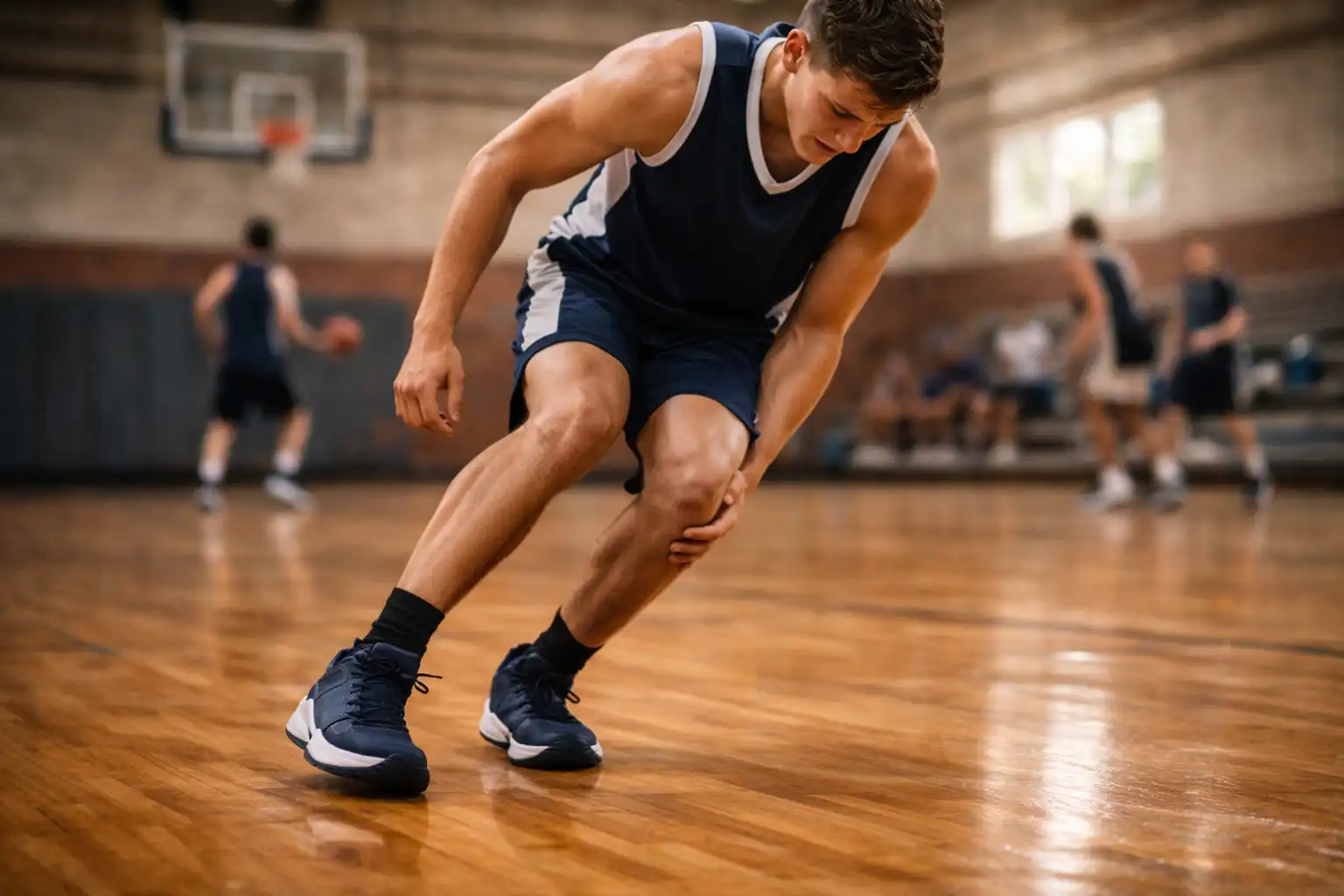
Why Basketball Players Get Injured & How Pre-Hab Prevents It
Every season, talented high school players watch their recruitment chances disappear — not because coaches weren't watching, but because they got hurt.
Youth sports injuries have been rising steadily for two decades. Basketball is among the most demanding on developing bodies — and most high school players have zero proactive injury prevention in place. Their warmup is a few laps around the gym. Their injury prevention plan is hoping for the best.
Understanding why players get hurt is the first step toward making sure it doesn't happen to you — or your athlete.
01 Overuse — The Silent Career Killer
The #1 cause of youth basketball injuries is overuse. Unlike a twisted ankle from landing wrong, overuse injuries build slowly — and don't always announce themselves until the damage is done.
Overuse happens when repetitive stress accumulates in a joint, tendon, or bone faster than the body can repair it. Classic examples include:
- Patellar tendinitis (jumper's knee) — chronic pain below the kneecap from repeated jumping
- Shin splints — stress on the tibia from high-volume running and cutting
- Stress fractures — micro-cracks from accumulated impact without adequate recovery
The culprit is too much volume, too little recovery. A 16-year-old playing 60+ games across multiple leagues with no structured rest isn't unlucky when they break down — it's biology.
A proper pre-hab program builds the supporting structures — tendons, ligaments, smaller stabilizing muscles — that absorb repetitive impact before it becomes injury. Strategic loading and recovery cycles train the body to handle volume, not just survive it.
02 Growth Plate Vulnerabilities
High school players are still growing — and that growth creates a specific injury risk that adult athletes don't face. Growth plates (areas of developing cartilage near the ends of long bones) are the weakest link in a young athlete's skeletal system — weaker than the tendons and ligaments attached to them.
Two of the most common growth plate conditions in basketball players:
- Osgood-Schlatter Disease — pain and swelling just below the kneecap, caused by repeated stress on the tibial growth plate. Most common in players ages 12–17 during growth spurts.
- Sever's Disease — heel pain from inflammation at the calcaneus growth plate. Particularly common in guards and players who cut and sprint at high volume.
Neither is a "disease" in the traditional sense — they're repetitive stress responses in bones that haven't finished forming. They develop quietly, and players often push through them until the pain becomes unmanageable.
Pre-hab protocols designed for developing athletes protect growth plates by strengthening surrounding musculature, improving shock absorption, and ensuring players build a strength base proportional to the demands being placed on their skeleton.
03 Poor Movement Mechanics
The most preventable acute injuries in basketball — ACL tears, ankle sprains, lower back strains — are rarely freak accidents. They're the result of movement patterns that place joints in vulnerable positions under load or at speed.
Common mechanical problems in youth players include:
- Knee valgus — knees collapsing inward on jumps and landings; a major ACL risk factor
- Forward trunk lean — overloads the lower back on cuts and drives
- Ankle instability — weak peroneals and poor single-leg balance
- Limited hip mobility — forces compensation patterns up the kinetic chain
- Asymmetrical strength — imbalances between left and right side that create mechanical vulnerability
These patterns develop early and go uncorrected — because no one is screening for them.
Pre-hab begins with identifying how a player actually moves — not just how they play — and correcting mechanical inefficiencies before they become injury mechanisms. Targeted exercises rebuild neuromuscular patterns, teaching the body to land safely, change direction efficiently, and absorb impact without loading vulnerable structures.
04 Lack of Mobility
Mobility — the ability to actively move a joint through its full range of motion with control — is one of the most overlooked injury risk factors in youth basketball. Most high school players have less of it than they think, and far less than they need.
Three of the most damaging mobility deficits in basketball players:
- Tight hip flexors (from prolonged sitting) force the lower back to compensate during jumping, cutting, and pivoting — leading to chronic back pain and disc issues.
- Limited thoracic mobility prevents proper shoulder mechanics, increasing rotator cuff injury risk for players who post up or engage in physical play.
- Restricted ankle dorsiflexion changes how a player lands after jumps, pushing forces up the chain into the knee — a key risk factor for patellar tendinitis and ACL injury.
The challenge: mobility restrictions don't hurt — until they do. Players play through them. Coaches don't notice them. Nothing changes until an injury forces intervention.
A structured pre-hab mobility routine done consistently before practice and games progressively improves range of motion in the joints that matter most for basketball. Better mobility means better mechanics, and better mechanics mean fewer injuries.
05 These Factors Don't Work Alone
Overuse, growth plate vulnerability, poor mechanics, and limited mobility rarely operate in isolation — they stack. A player with tight hips, poor landing mechanics, and a heavy game schedule is at dramatically higher risk than a player dealing with just one of those issues.
And yet, most youth basketball players have no pre-hab protocol whatsoever.
Rehab fixes the car after the accident.
Pre-hab is wearing the seatbelt before you get on the road.
06 Pre-Hab Isn't Rehab. It's Insurance.
Rehabilitation happens after an injury occurs. Pre-habilitation is designed to prevent the injury from happening in the first place.
For high school players chasing recruitment, staying on the court is everything. A torn ACL doesn't just mean six months of recovery — it means games missed, highlights not recorded, coaches who stop following your progress. The recruiting window is narrow. Injuries make it narrower.
The players who make it to the next level aren't just the most talented. They're the ones who stay healthy long enough to be seen.
High School Basketball Portal · Free for All Players
Get Recruited. Stay Healthy.
HSBP is the only recruiting platform built with Pre-Habilitation as a core feature. Access injury prevention programs, mobility routines, and warm-up protocols — free.
Register Free Today