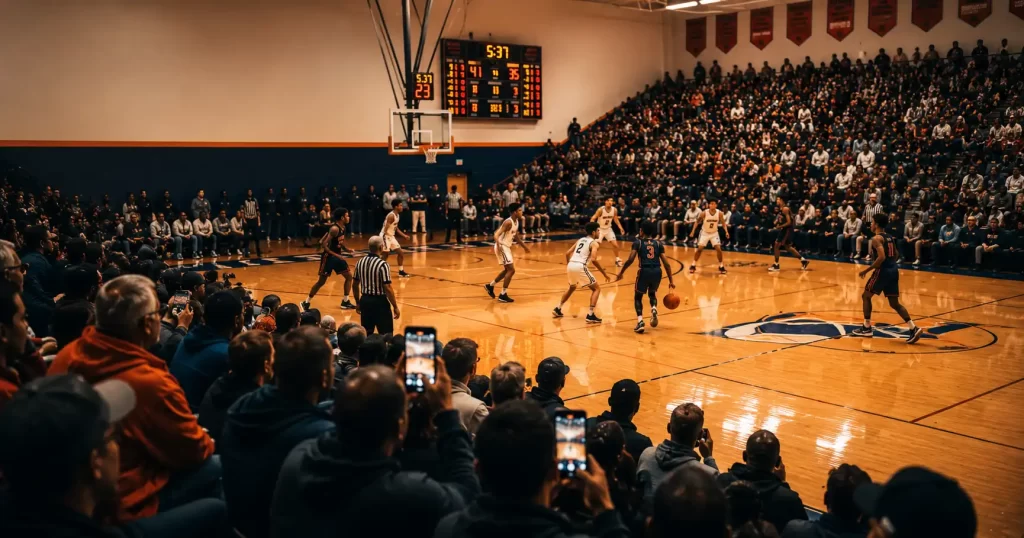
Basketball is a remarkably stable game. From the moment it was invented in 1891, the rules and rhythms have changed only at the margins. I’ve watched this sport for more than four decades, and I believe we’re standing at the edge of the biggest shift any of us have seen — one driven by money, politics, and a slow drift away from the things that made the game worth watching in the first place. And the place it’s shifting toward is the high school gym.
Money, politics, and a restless chase for the next level are reshaping basketball —
and pushing its center of gravity toward the high school gym.
01 A Game That Rarely Changes — Until Now
James Naismith invented basketball in 1891 during a harsh New England winter, tasked with inventing an indoor game to keep restless students active. The first game followed in 1892, and from there, true structural change has been rare. The single biggest modern change was the NBA adopting the three-point line for the 1979–80 season. The league itself began as the Basketball Association of America in 1946 — founded largely by hockey-arena owners looking to fill empty buildings — and became the NBA in 1949. On the college side, the NIT was once the dominant postseason event before the NCAA tournament overtook it in prominence in the late 1960s.
That stability is exactly why what’s happening now matters. When a game changes this little for this long, a genuine inflection point is worth paying attention to.
02 Why the Pro and College Game Are Losing Their Grip
I’d argue the NBA has become more spectacle than sport. The three-point shot now dominates possessions, and the connection between effort and outcome can feel thinner than it used to. The college game is fraying for different reasons. With players free to transfer without sitting out, and with the one-and-done pipeline pulling the best talent through in a single season, it’s hard to form any real attachment to your favorite team — or even your own alma mater. Rosters turn over wholesale every spring as players chase minutes and money.
None of this is the players’ fault; it’s the structure. The financial arms race and the churn of the portal have made the upper levels of the game feel transactional. If you want to understand how that money now reaches down into the youth game, our look at when club and AAU basketball helps and when it hurts is a useful companion, as is our overview of the NIL landscape and the legal support families now need.
03 High School Is Where the Game Stays Pure
Consider the scale. Basketball trails only soccer as the most popular sport on the planet — and in the U.S. its reach is unmatched: across roughly 27,000 high schools, it’s offered more widely than any other boys’ sport.
Here is the part I feel most strongly about. High school basketball is the last level where players put it all on the floor and play every night like it’s their last game. The best programs are coached by people who still emphasize fundamentals and the habits that build a complete player, and who teach defense as something more than an afterthought. The result is a game with real basketball IQ and decision-making on display — and a crowd that actually knows the kids on the court.
It’s also where evaluation is still honest. The legendary scout Thomas Konchalski built a career on watching high school players with nothing but a notebook and his own eyes; our tribute to him is a reminder of what real assessment looks like when it isn’t buried under hype.
The only level where players still leave everything on the floor —
for their school, their town, and the kid next to them on the bench — is high school basketball.
04 The Money and the Institutions Are Moving Down to the Prep Level

Follow the money and you’ll see where this is going. Elite prep programs have already organized into a national super-league: what launched in 2021–22 as the National Interscholastic Basketball Conference is now the Nike EYBL Scholastic conference, running roughly 20 teams across two divisions with games carried on ESPN platforms — Montverde, IMG Academy, Oak Hill, Sunrise Christian, Wasatch, La Lumiere, Long Island Lutheran, Link Academy and others. The GRIND Session is a separate national circuit playing weekends in major cities. And hundreds of high school games now stream nightly on services like BallerTV.
Big capital sees it too. In 2023, Endeavor sold IMG Academy — the Bradenton, Florida sports-education institution — to private-equity firm BPEA EQT for $1.25 billion, in partnership with Hong Kong-headquartered school operator Nord Anglia Education (EQT is the Sweden-based private-equity group behind the deal). High-profile figures have launched basketball-focused academies of their own. When institutional money flows toward a level of the game, it’s a signal — and right now it’s flowing toward the prep and academy pathway.
05 The International Lesson

The strongest evidence that development — not the league of origin — makes the player is the NBA itself. The 2025–26 season opened with a record 135 international players from a record-tying 43 countries, and the league’s recent MVP awards have gone almost entirely to players developed overseas: Jokić, Antetokounmpo, Embiid, and the Dončić-era European wave. There is no high school or college basketball internationally; everything runs through the club system, where young players are trained from the earliest age in spacing, ball-handling, shooting and defense regardless of size.
That European club model produces complete players, and it should sharpen how we think about the American game. You can see how that same logic shapes recruiting for players coming through our international recruiting portal.
06 Washington Steps In
The instability at the college level has now drawn the federal government in. On April 3, 2026, President Trump signed an executive order titled “Urgent National Action to Save College Sports.” It takes effect August 1, 2026, applies to schools with at least $20 million in annual athletics revenue, and uses eligibility for federal grants and contracts as the enforcement lever — directing the NCAA to update its rules on NIL, transfers, and eligibility by that deadline or risk funding consequences.
The order, in brief
Effective Aug. 1, 2026 · applies to programs with $20M+ in athletics revenue · targets NIL, transfers, and eligibility · enforced through federal grant and contract eligibility. (My own read is that it will also make life harder for professional players abroad who never attended college and chase big U.S. incentives — though the order itself doesn’t single them out, and the rules will be difficult to monitor and likely to draw litigation.)
Whatever you think of the politics, the takeaway is the same: the college game is being actively re-engineered from the outside. Stability is moving elsewhere. For families weighing the value of the high school years themselves, our piece on how high school basketball helps with college admissions and our breakdown of what college coaches actually look for are worth a read.
07 Where This Is Headed — and What It Means for Your Family
Here’s my prediction. Over the next decade, I expect high school basketball to become the most-watched and most-attended form of organized basketball in America — and the most defensible investment of a young player’s time. I think we’ll eventually see a true national tournament of 64 or even 128 teams, far broader national television coverage, and international scholastic competition against the clubs of Europe, Australia and beyond. One honest caveat worth stating plainly: this growth story is about viewership, attendance, streaming and commercial investment — not raw participation, which has held roughly flat. The opportunity is in attention and infrastructure, and both are pointing the same direction.
For parents and coaches, the practical message is simple. The high school years are no longer just a stepping stone — they’re becoming the main stage. Make them count.
The Pro & College Game Today
- Rosters turn over every season via the portal and one-and-done
- Three-point volume over all-around fundamentals
- Weakening fan and alma-mater connection
- A financial arms race now reshaped by federal mandate
The High School Game
- Roster and team identity tied to a school and a town
- Coaching built on fundamentals and defense
- Crowds that know the players personally
- Full effort, every night, with everything on the floor
Sources: NBA opening-night international-player roster release (2025–26 season); FIBA/Nielsen global sport-popularity research; NCES and NFHS data on U.S. high school counts and sport sponsorship; reporting on Endeavor’s 2023 sale of IMG Academy to BPEA EQT and Nord Anglia Education; and the April 3, 2026 Executive Order, “Urgent National Action to Save College Sports.” This article reflects the author’s opinion and is general commentary, not legal or financial advice.
High School Basketball Portal · Free Player Membership
Get Your Player Seen by College Coaches
Coaches can’t recruit what they can’t see. Build a verified profile, put your highlights in front of college coaches, and stay in the conversation when roster spots open — no travel circuit required. Player registration is free, and coaches can manage and share their rosters from the coaches’ side of the platform.
Create a Free Player Profile