Every basketball player knows the feeling. You're driving to the basket, you come down off a jump, and your ankle rolls. One wrong landing — and just like that, you're on the bench for weeks while your teammates keep practicing, keep improving, and keep getting seen by college coaches.
Ankle sprains are the single most common injury in basketball. Studies show that nearly 25% of all basketball injuries involve the ankle — and most of them are preventable.
The good news? You don't need expensive equipment or hours of extra training to protect your ankles. You need the right exercises, done consistently. That's what Pre-Habilitation is all about — training your body to handle the demands of the game before an injury happens.
01 Why Basketball Players Are So Vulnerable to Ankle Injuries
Basketball is a sport built on explosive movements — cuts, pivots, jumps, and rapid direction changes. Every one of those movements puts significant stress on your ankle joint. When the muscles and tendons around the ankle are weak or poorly trained, the joint can't stabilize itself fast enough. That's when you roll, sprain, or worse.
Here's what makes ankle injuries especially dangerous for aspiring college athletes:
- They compound. Once you sprain an ankle, the surrounding ligaments stretch and weaken. Without proper prehab, you're significantly more likely to sprain the same ankle again.
- They sideline you at the worst times. Recruiting season doesn't pause for injuries. If you're on the bench during a showcase or camp, coaches move on.
- They affect your long-term career. Chronic ankle instability can follow players into college and beyond, limiting performance and increasing the risk of more serious injuries.
The solution isn't to play through the pain — it's to build the ankle strength and neuromuscular control that prevents the injury from happening in the first place.
02 Understanding Proprioception: Your Ankle's Hidden Superpower
Before we get into the drills, you need to understand proprioception — and why it matters more than simple muscle strength.
Proprioception is your body's ability to sense its own position in space. Think of it as your internal GPS. When your foot lands on the court at an angle, tiny sensors in your muscles, tendons, and ligaments send signals to your brain telling it exactly where your ankle is. Your brain then fires the right muscles to stabilize the joint — in milliseconds.
In players with poor proprioception, this system is slow or unreliable. The stabilizing muscles react too late, and the ankle gives out.
Proprioception is trainable. The balance drills and progressive exercises below will rewire your neuromuscular system, making your ankles faster, smarter, and stronger.
03 Part 1 — Balance Drills
Train your nervous system to stabilize the ankle under increasingly challenging conditions
Perform this routine 3–4 times per week, ideally before practice or as part of your warm-up. You only need about 15–20 minutes.
Single-Leg Balance Hold
Stand on one foot with a slight bend in the knee. Hold for 30 seconds. Rest, then switch feet. That's one set — do 3 sets per foot.
Progression
Close your eyes to eliminate visual feedback, forcing your ankle and lower leg to do all the stabilizing work. This single change dramatically increases the difficulty and training stimulus.
Single-Leg Alphabet
Stand on one foot. Using your raised foot, trace the letters of the alphabet in the air by moving only from the ankle — not the hip or knee. This sounds simple. It's not. The alphabet drill moves your ankle through nearly every plane of motion while challenging the stabilizers. Do A–Z on one foot, then switch.
Single-Leg Mini Squat
Stand on one foot. Perform a slow, controlled squat to about 30–45 degrees of knee bend, then return to standing. Focus on keeping your ankle stable — don't let it wobble inward or outward.
Challenge
Add a slight forward trunk lean to better simulate landing mechanics.
Perturbation Training (Partner or Wall)
Stand on one foot. Have a partner lightly push your shoulder from different angles — forward, backward, side to side. Your job is to maintain balance without putting your foot down.
Solo Version
Stand on one foot near a wall and lightly tap with your fingertips at random intervals, removing contact each time. This trains reactive stabilization.
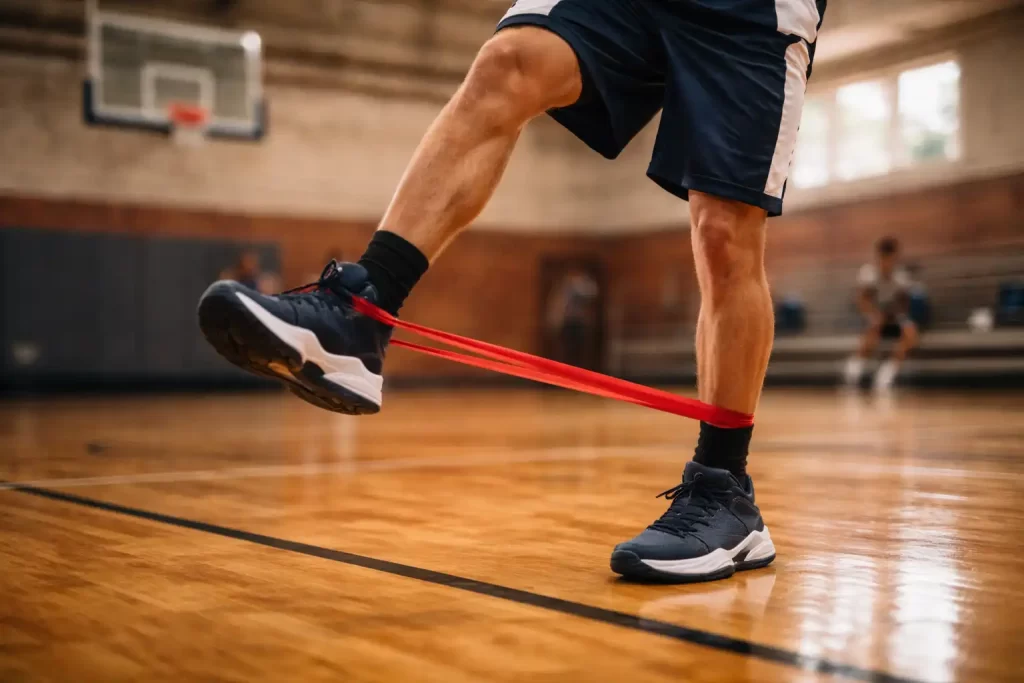
04 Part 2 — Resistance Band Work
Ankle sprains happen in multiple directions — your strengthening must cover all planes of motion
Use a light-to-medium resistance band for the following exercises.
Banded Dorsiflexion (Toes Up)
Sit with your leg extended. Loop the band around the top of your foot and anchor the other end. Pull your toes toward your shin against the band's resistance. Return slowly. 3 sets · 15–20 reps per foot.
Why It Matters
Weak dorsiflexors are a major contributor to ankle sprains. This exercise directly strengthens the front of the lower leg.
Banded Plantarflexion (Toes Down)
Sit with your leg extended. Loop the band around the ball of your foot, anchoring the other end behind you. Push your toes away from your body (like pressing a gas pedal) against resistance. Return slowly. 3 sets · 15–20 reps per foot.
Banded Inversion (Foot Rolls In)
Sit with your foot in a neutral position. Loop the band around the inside of your foot. Rotate your foot inward (sole faces the other foot) against resistance. Return slowly. 3 sets · 15 reps per foot.
Banded Eversion (Foot Rolls Out) — Most Important
Loop the band around the outside of your foot. Rotate your foot outward against resistance. Return slowly. 3 sets · 15 reps per foot.
Why It Matters
The peroneal muscles on the outside of your ankle are your primary defense against inversion sprains — the most common type in basketball. Eversion strengthening directly trains these muscles to fire faster and harder.
05 Part 3 — Functional Progression
Take the isolated training and make it basketball-specific
Single-Leg Box Step-Down
Stand on a low box or step (6–8 inches). Step one foot down, lightly tap the floor, then return to standing. Focus on controlling the lowering phase — your ankle should stay stable throughout. 3 sets · 10 reps per leg.
Lateral Hop to Hold
Hop laterally (side to side) from one foot to the other. When you land on each foot, hold the landing for 3 seconds before hopping again. Emphasize a soft, controlled landing — not crashing down. 3 sets · 10 hops per direction.
Forward & Lateral Bound to Balance
Take a single aggressive bound forward or laterally, land on one foot, and hold the balance for 3 seconds. This simulates the exact forces of a drive, cut, or defensive slide. 3 sets · 8 bounds per leg.
06 Pro Tips for Maximum Results
- Consistency beats intensity. 3–4 times per week beats grinding through it once. Neuromuscular adaptations require repetition over time.
- Don't skip the eccentric phase. The slow return in every banded exercise is where much of the strength benefit comes from. Don't rush it.
- Train unstable surfaces. A folded yoga mat or BOSU ball adds a proprioceptive challenge once you've mastered the basics on flat ground.
- Train both ankles equally. Even if you've only sprained one ankle, train both the same. Imbalances between sides increase injury risk.
- History of sprains? Tell your coach. Previous sprains create lasting proprioceptive deficits. You may benefit from working with a physical therapist or athletic trainer in addition to this routine.
07 What College Coaches Actually Want
Here's something most players don't think about: college coaches recruit durability, not just talent.
A player who misses weeks every season due to recurring ankle sprains is a recruiting risk. Coaches at every level — Division I, II, III, NAIA, and JUCO — consider injury history when evaluating prospects. An athlete who is clearly taking proactive steps to stay healthy signals maturity, dedication, and coachability.
That's exactly why High School Basketball Portal built Pre-Habilitation content directly into the platform. We believe that the players who work the hardest to protect their bodies are the ones coaches want on their roster.
College coaches recruit durability, not just talent.
Protect your ankles. Protect your future.
High School Basketball Portal · Free for All Players
Stay on the Court. Get Recruited.
HSBP is the only recruiting platform built with Pre-Habilitation as a core feature. Access injury prevention programs, mobility routines, and warm-up protocols — free.
Join Free Today