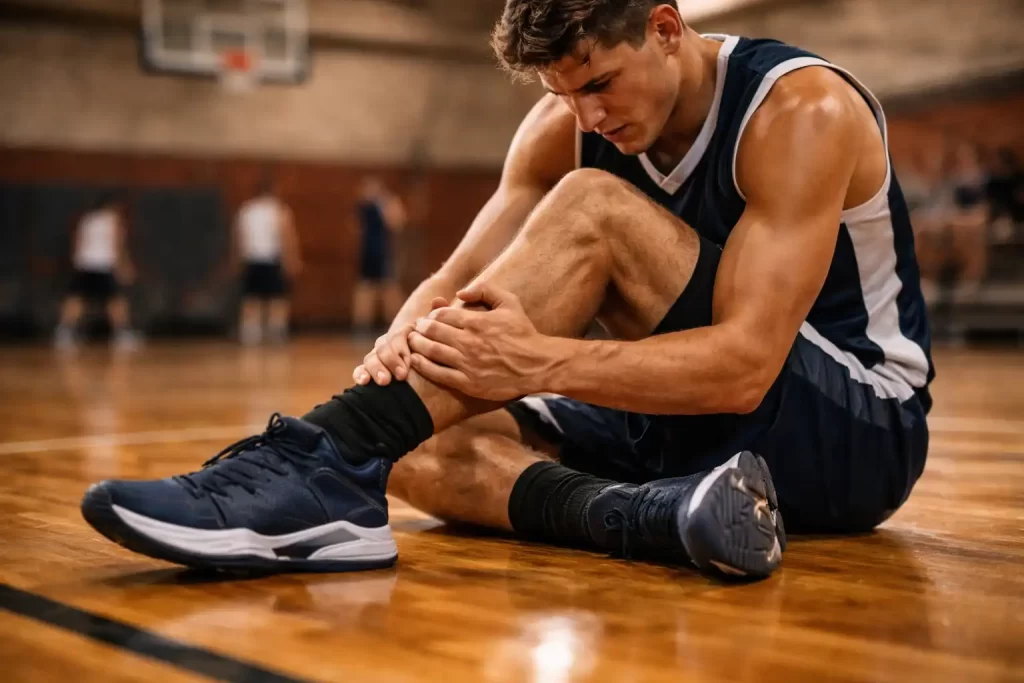
Every basketball player knows the sound. A misstep coming off a pick-and-roll. A hard cut to the basket. A landing that doesn't feel right. Then the whistle stops. The trainer jogs out. And a season — or a career — hangs in the balance.
High school basketball players are among the most injury-prone athletes in youth sports. The combination of rapid physical development, year-round play, high court demands, and bodies still growing creates a perfect storm for overuse and acute injuries alike.
But here's what most players — and parents — don't know: the majority of these injuries are preventable. Not with luck. With preparation.
This is what Pre-Habilitation is all about — training your body before an injury happens so you never have to rehab your way back. At the High School Basketball Portal, we believe every player deserves access to the knowledge that keeps them on the court, not on the sideline.
01 Ankle Sprains
The most common basketball injury at every level of play
Ankle sprains happen when the ligaments on the outside of the ankle are stretched or torn — usually when a player lands on another player's foot, makes a sharp cut, or comes down awkwardly from a jump. Lateral (inward rolling) sprains are by far the most frequent.
Why High School Players Are Vulnerable
Growing athletes often have underdeveloped proprioception — the body's ability to sense position and balance. Add in fatigue during late-game situations and it's a recipe for a rolled ankle.
Warning Signs
Chronic ankle "wobble," a history of minor sprains you shook off, weakness on the outside of the ankle, or soreness after jumping drills.
Prevention
- Single-leg balance drills — build proprioception daily, even 5 minutes makes a difference
- Ankle strengthening with resistance bands — eversion and inversion exercises
- Calf raises with a slow, controlled eccentric phase
- Jump landing mechanics training — land with soft knees, not stiff legs
- Proper footwear with ankle support and a non-slip sole
Key Mistake
Returning too soon after a minor sprain. Incomplete recovery weakens the ligament and dramatically increases re-sprain risk. One sprain often becomes two, then three.
02 Knee Injuries (ACL & Meniscus)
The injury every player and parent fears most
ACL tears are catastrophic — they typically mean 9–12 months of recovery and often alter a player's game permanently. Meniscus tears can also sideline a player for months and lead to long-term knee issues. Both injuries spike during deceleration, pivoting, cutting, and jump landings.
Why High School Players Are Especially at Risk
Female athletes are 2–8 times more likely to suffer an ACL tear than male athletes, largely due to differences in lower limb alignment and movement patterns. But male players are far from immune, especially during growth spurts when coordination and strength temporarily fall behind bone growth.
Warning Signs
Knee pain during or after cutting or jumping, a sense of instability ("my knee gives out"), swelling that doesn't fully resolve between practices.
Prevention
- Neuromuscular training programs — the FIFA 11+ and PEP programs have documented evidence of reducing ACL injury rates by up to 50%
- Hip abductor and glute strengthening — weak hips shift load to the knee
- Hamstring strengthening — Nordic curls are particularly effective
- Jump-landing mechanics — land with hips back, knees over toes, slight hip hinge (not knees caving inward)
- Single-leg squat training to identify and correct imbalances between legs
Pre-Hab Impact
Players who go through structured knee-stability training measurably reduce their injury risk — and college coaches are increasingly aware of which programs prioritize this.
03 Achilles Tendon Injuries
A slow build that ends in a sudden, devastating snap
Achilles injuries range from tendinopathy (chronic soreness and stiffness) to partial or full ruptures — one of the most feared injuries in sports. Full ruptures typically require surgery and 9–12 months of recovery, with some players never fully returning to their prior explosiveness.
Why High School Players Are Vulnerable
Rapid growth spurts can tighten the calf-Achilles complex, and players who dramatically increase training volume (summer leagues, AAU seasons) without adequate rest overload the tendon.
Warning Signs
Morning stiffness in the back of the heel, tenderness when pinching the tendon, pain that warms up during activity but returns afterward, a visible "bump" on the tendon.
Prevention
- Eccentric calf raises — gold standard for Achilles health (lower heel slowly off the edge of a step, rise with both feet)
- Never ignore Achilles soreness — it compounds rapidly
- Increase training load gradually — no more than 10% volume increase week-to-week
- Adequate warm-up before explosive activity — cold tendons are vulnerable tendons
- Stretch the calf and soleus daily, especially during growth periods
Critical
If there is any persistent soreness in the back of the heel, reduce load immediately. This is one injury where powering through makes it dramatically worse.
04 Patellar Tendon Injuries
Jumper's Knee — the bane of explosive athletes everywhere
"Jumper's Knee" — or patellar tendinopathy — is chronic pain and inflammation in the patellar tendon, which connects the kneecap to the shinbone. It's caused by repetitive stress from jumping, landing, and accelerating. It's so common in basketball that it earned its nickname from the sport.
Why High School Players Are Vulnerable
Young athletes playing multiple leagues simultaneously — high school season, AAU season, open gyms — accumulate tendon stress without adequate recovery. The tendon never gets a chance to adapt.
Warning Signs
Pain at the bottom of the kneecap that worsens with jumping and squatting; stiffness at the start of activity that eases up as you warm up then worsens again after; tenderness to direct touch just below the kneecap.
Prevention
- Eccentric single-leg squats on a decline board — most evidence-supported intervention for patellar tendinopathy
- Quad strengthening — weak quads transfer more load to the tendon
- Load management — monitor and limit total jump volume across all programs
- Hip flexor and quad flexibility work to reduce anterior knee tension
- Address foot pronation if present — flat arches increase tendon load
Good News
Unlike most injuries, jumper's knee responds well to a structured prehab program even in symptomatic stages. Early identification + structured response = players can often continue training with modifications.
05 Shin Splints
The grinding ache that gets worse every practice
Shin splints refer to pain along the inner edge of the shinbone, typically caused by overuse, training surface changes (hard courts), and increased mileage. They're extremely common in pre-season when players ramp up conditioning after a period of reduced activity.
While shin splints are often dismissed as "just part of playing," they exist on a spectrum with stress fractures — and ignoring them can push a player from manageable discomfort to a serious bone injury.
Why High School Players Are Vulnerable
Pre-season conditioning ramps, hard gymnasium floors, and players returning from summer breaks with deconditioned lower legs are the primary culprits. Flat arches and overpronation also increase tibial stress.
Warning Signs
Dull, diffuse aching along the inner shinbone during and after exercise; pain worse at the start of practice that may ease mid-session but return afterward; soreness to touch along the inner tibia.
Prevention
- Gradual return to high-mileage training — never jump back to full conditioning after a break
- Calf and tibialis anterior (front of shin) strengthening
- Foot strengthening exercises — arch support and intrinsic foot muscles reduce load transfer to the tibia
- Appropriate footwear with adequate cushioning and arch support
- Foam rolling the calf and tibial area to manage tissue tension
- If flat-footed, consider properly fitted orthotics
Critical Note
If shin pain becomes localized to a very specific, small spot — rather than diffuse along the shin — see a medical professional immediately. This can indicate a stress fracture requiring rest and potentially imaging.
06 Hip Flexor & Groin Injuries
Underrated, often ignored, and a sneaky season-ender
Hip flexor strains and groin pulls are less dramatic than ACL tears or Achilles ruptures, but they sideline players for weeks and, when managed poorly, become chronic and recurring. Hip injuries affect speed, cutting ability, and jumping — in other words, everything that makes a basketball player dangerous.
Why High School Players Are Vulnerable
Tight hip flexors from long hours of sitting (school, studying, gaming) combined with explosive athletic demands create a significant mismatch. Players with poor hip mobility and weak glutes place more load on the hip flexors and groin.
Warning Signs
Tightness or pulling in the front of the hip during high knees or explosive sprints; groin soreness after lateral defensive drills; pain when kicking through or driving a knee upward.
Prevention
- Hip flexor stretching daily — the standing lunge stretch and couch stretch are essentials
- Glute strengthening — strong glutes reduce demand on the hip flexors
- Adductor strengthening — Copenhagen plank variations are highly effective for groin resilience
- Dynamic warm-up including leg swings, hip circles, and lateral band walks
- Avoid static stretching cold — warm up dynamically before games and practices
Remember
Hip injuries that aren't properly rehabbed become nagging recurrences. Many players carry chronic hip soreness for full seasons because they never fully addressed the first injury.
07 Stress Fractures
What happens when bones are pushed past their limit
Stress fractures are small cracks in bone caused by repetitive force over time — the bone doesn't get enough recovery to rebuild between training sessions. In basketball players, the most common sites are the tibia (shin), metatarsals (foot bones), and navicular (a small foot bone critical to athletic performance).
Navicular stress fractures are notorious for being missed and underestimated — and they can derail a season or even a career if not properly managed.
Why High School Players Are Vulnerable
Players undergoing rapid growth spurts have temporarily weaker bone mineral density at the growth plates. Year-round training without adequate rest elevates risk significantly. Poor nutrition — particularly inadequate calcium and Vitamin D — increases stress fracture susceptibility.
Warning Signs
Deep, localized bone pain that doesn't respond to ice or rest; pain that worsens progressively with activity; tenderness at a very specific point on the bone; swelling without a clear acute injury.
Prevention
- Adequate rest — at least one full rest day per week and planned off-seasons
- Nutrition: ensure adequate calcium (dairy, leafy greens, fortified foods) and Vitamin D (sunlight exposure, supplementation if deficient)
- Gradual load progression — no sudden spikes in training volume
- Strength training — stronger muscles absorb more force, reducing bone stress
- Proper footwear to cushion impact forces
Stop — Do Not Push Through
If a stress fracture is suspected, stop immediately. Stress fractures that progress to complete fractures require significantly longer recovery and, in some sites like the navicular, surgical intervention.
08 The Common Thread: Prevention Is the Play
Looking at all 7 injuries, a clear pattern emerges. They share common risk factors — and all of them are addressable:
- Rapid increases in training volume without adequate preparation
- Weakness in key supporting muscle groups
- Poor landing and movement mechanics
- Insufficient recovery between sessions
- Lack of a structured warm-up and cool-down routine
None of these require expensive equipment or access to an elite training facility. They require knowledge, consistency, and the willingness to invest in your body the same way you invest in your game.
This is precisely why the High School Basketball Portal has built Pre-Habilitation into the core of its platform. Players who understand their bodies, train smart, and prevent injuries are not only healthier — they're more attractive to college coaches. Durable athletes are valuable athletes.
Durable athletes are valuable athletes.
Prevention isn't cautious — it's competitive.
High School Basketball Portal · Free for All Players
Stay on the Court. Get Recruited.
HSBP is the only recruiting platform built with Pre-Habilitation as a core feature. Access injury prevention programs, mobility routines, and warm-up protocols — free.
Join Free Today