
Why the Balls of the Feet Are Critical for Basketball Performance & Injury Prevention
Most basketball injuries don't start with your knees, ankles, or hips. They start with the ground — and how your feet meet it.
Every elite basketball player relies on an invisible foundation — the ball of the foot. Whether you're exploding off the floor on a fast break, planting for a crossover, or landing after a contested dunk, the forefoot is where athletic force begins and ends. Yet this critical area is rarely trained, rarely discussed, and almost never included in standard warm-up routines.
Understanding the ball of the foot in basketball — its role in forefoot loading, jumping mechanics, balance, and push-off power — isn't just biomechanics trivia. It's the difference between an athlete who stays on the court and one who ends up on the sideline.
At the High School Basketball Portal, our Pre-Habilitation content is built around one goal: giving high school and JUCO players the tools to perform at their best and stay healthy long enough to be seen by college coaches. This article breaks down why the balls of the feet matter so much — and what you can do today to protect and develop them.
01 What Is the "Ball of the Foot" — and Why Does It Matter?
The ball of the foot refers to the padded area on the underside of the foot, located just behind the base of the toes. Anatomically, it sits over the heads of the metatarsal bones — the five long bones that connect the heel to the toes. This region is the primary contact point between your body and the floor during most basketball movements.
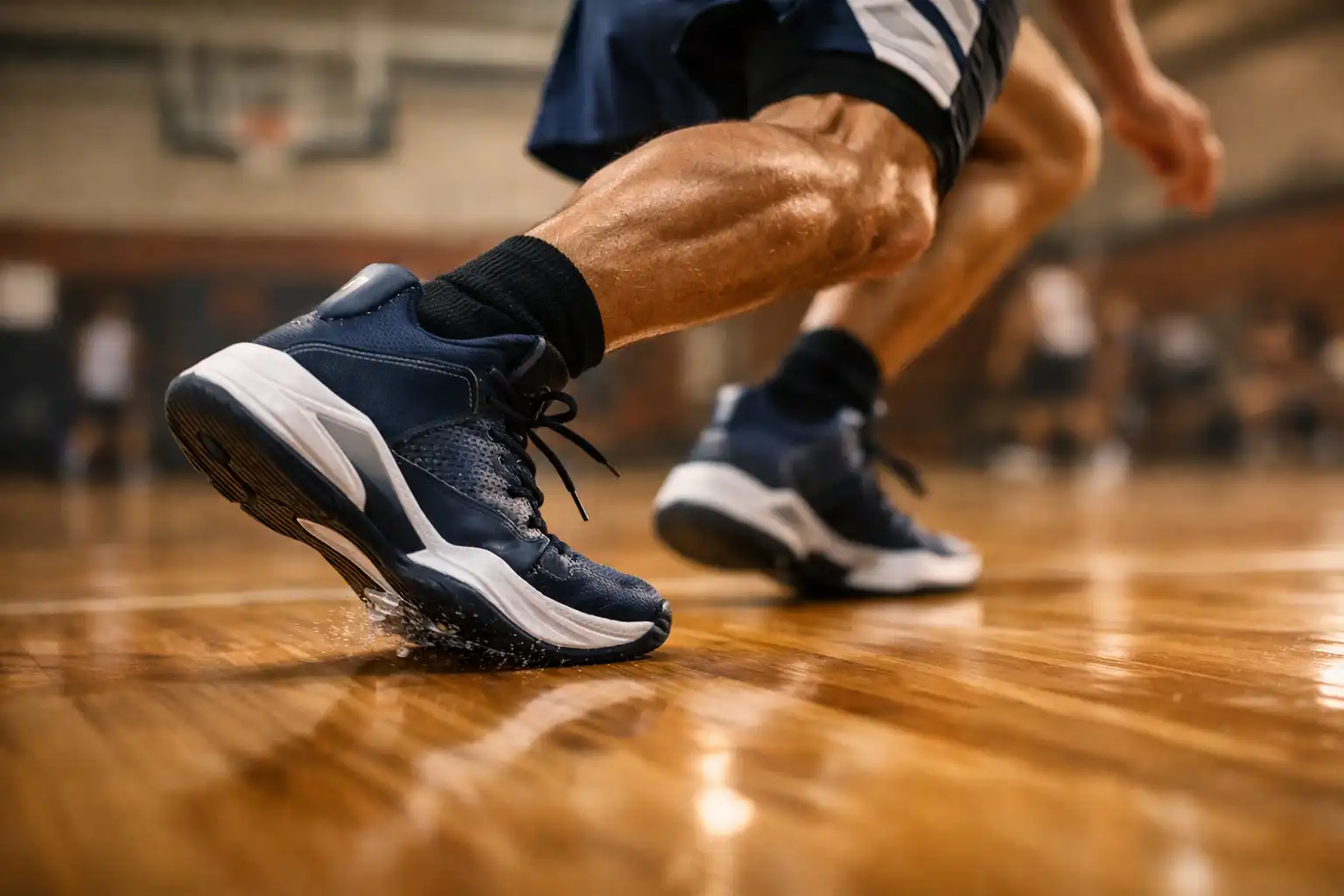
In a sport that demands instant acceleration, sharp cuts, vertical jumps, and controlled landings, the forefoot is working in overdrive. Unlike walking or jogging — where the heel strikes first — basketball is almost entirely a forefoot-dominant activity. You push off from the balls of your feet. You land on the balls of your feet. You pivot on them. You change direction through them.
The Metatarsal Connection
The five metatarsal bones fan out across the midfoot and terminate at the metatarsal heads — the bony bumps you can feel when you press the ball of your foot. These heads form a natural structure called the transverse arch, which absorbs and distributes force across the forefoot. When this area is not properly conditioned, the arch flattens under load — and that flattening can trigger a cascade of problems that climb up the kinetic chain: plantar fasciitis, shin splints, knee pain, and even hip stress.
Key Anatomy Takeaway
The ball of the foot is not just soft tissue — it's the junction of bone, cartilage, tendons, and fascia that bear the lion's share of basketball's explosive forces. Train it, or lose it.
02 Forefoot Loading: The Engine Behind Every Basketball Movement
Forefoot loading describes what happens when body weight and momentum are concentrated on the front of the foot during athletic movement. In basketball, this isn't occasional — it's constant.
Consider a standard defensive stance: feet shoulder-width apart, knees bent, weight forward on the balls of the feet. The player is in a state of perpetual forefoot loading, ready to react in any direction. The moment the opposing player moves, the defending athlete pushes off the forefoot to accelerate. If those forefoot structures aren't conditioned to handle rapid, repeated loading, something eventually gives.
The Physics of Forefoot Loading
When a basketball player is in motion, forces passing through the forefoot can reach two to three times body weight. For a 170-pound player, that's 340 to 510 pounds of force passing through the ball of the foot with every significant move. Multiply that by hundreds of repetitions in a single game, and across an entire season, the cumulative stress is enormous.
The intrinsic muscles of the foot — the small muscles inside the foot itself — serve as the first line of defense. When they're strong, they absorb and distribute load effectively. When they're weak (extremely common in modern players who train in heavily cushioned shoes), the forefoot compresses, toes splay, and the Achilles and plantar fascia take on excessive load.
Warning Signs of Poor Forefoot Loading Mechanics
- Heel-striking during cuts or direction changes
- Discomfort or numbness under the ball of the foot after practice
- Collapsing arches or excessive inward rolling (overpronation)
- Chronic shin splints or Achilles tightness
- Difficulty maintaining a low defensive stance for extended periods
03 Jumping Mechanics: How the Forefoot Powers Vertical Explosiveness
Ask any coach what separates a good player from a great one, and vertical leap almost always comes up. And while the glutes, hamstrings, and quads are rightly credited for jump power, the ball of the foot is the final link in that chain — the point where all that muscular force transfers into the floor.
Phase 1: The Load
As you begin your jump, you drop into a slight squat (the countermovement). Your weight shifts forward onto the balls of your feet. The forefoot structures load eccentrically — storing elastic energy like a compressed spring. A stiff, poorly conditioned forefoot can't store energy efficiently here, meaning that energy is lost rather than returned.
Phase 2: The Push-Off
As you extend your hips, knees, and ankles, the final push comes through the ball of the foot and toes. This is sometimes called triple extension, and the toe-off moment — where only the balls of the feet and toes remain in contact with the floor — determines how much force actually propels you upward. Athletes with strong, mobile forefeet generate more force at toe-off. Athletes with weak or rigid forefeet leave energy on the table.
Phase 3: The Landing
This is where injuries happen most often. Landing incorrectly — on the heel, flat-footed, or with poor forefoot control — creates jarring impact forces that bypass the body's shock-absorption system. A controlled forefoot landing — where the ball of the foot contacts first, followed by a soft heel drop — allows the ankle, knee, and hip to absorb force progressively. Without that forefoot control, all of that energy goes straight to the joints.
Performance Fact
Research in sports biomechanics consistently shows that athletes who land with greater forefoot control demonstrate significantly lower injury rates at the knee and ankle. Improving forefoot mechanics isn't just prehab — it's direct performance enhancement.
04 Balance: The Forefoot as Your Body's Stability Center
Balance in basketball is not static — it's dynamic. You're constantly managing your center of gravity against an opponent, the court, and your own momentum. The forefoot plays a quiet but essential role through a system called proprioception.
Proprioception is your body's ability to sense its own position in space. The ball of the foot is densely packed with proprioceptive nerve endings — sensors that continuously feed your nervous system information about ground surface, foot position, and load distribution. This real-time feedback allows micro-corrections that keep you balanced and injury-free.
When Forefoot Proprioception Breaks Down
Athletes who have had ankle sprains, plantar fasciitis, or other foot injuries often experience reduced proprioceptive sensitivity — even after the pain is gone. This is one reason why a sprained ankle dramatically increases the risk of a second sprain: the sensory feedback loop is compromised. Overuse of heavily cushioned footwear during non-playing hours can also blunt proprioception over time.
Balance Training for the Forefoot
- Single-leg stands on a balance board or foam pad — weight on the ball of the foot
- Barefoot towel scrunches: scrunch a towel with your toes to activate intrinsic foot muscles
- Single-leg Romanian deadlifts with slow eccentric emphasis to challenge forefoot stability under load
- Calf raise progressions on the edge of a step with a pause at the top
- Reactive balance drills: partner pushes or ball tosses in single-leg stance
05 Push-Off Power: Maximizing Force Through the Forefoot
Every explosive move in basketball — first-step acceleration, lateral cuts, drive finishes at the rim — depends on the quality of push-off from the forefoot. Push-off power is the product of two things: muscular strength and stiffness of the foot's tendons and fascia.
The plantar fascia — the thick band of connective tissue running from heel to forefoot — functions as a windlass mechanism. As the toes extend during push-off, the plantar fascia tightens, raising the arch and stiffening the foot into a rigid lever. This stiffness is what allows the foot to efficiently transfer muscular force into the floor.
The Big Toe's Outsized Role
The big toe (hallux) is one of the most important structures for basketball performance. The first metatarsophalangeal joint must extend significantly during push-off for the windlass mechanism to activate properly. Restricted big-toe extension — called hallux limitus — forces compensations at the ankle, knee, and hip, reduces push-off power, and can contribute to plantar fasciitis, shin splints, and even stress fractures in the other metatarsals.
Prehab Priority
Spend 2 minutes before every practice mobilizing the big toe: gently extend it back toward the shin while pressing the ball of the foot down. This simple habit can significantly improve push-off mechanics and reduce plantar fascia stress over time.
Exercises to Build Push-Off Power
- Banded big-toe extensions: loop a light resistance band around the big toe and practice slow extensions against resistance
- Single-leg calf raises with a 3-second hold at the top (forefoot emphasis)
- Depth drops: step off a 6–8 inch box and land on the forefoot, immediately absorbing and rebounding
- Broad jumps with focus on pushing through the ball of the foot at takeoff
- Resisted sprint starts with a partner holding a band at your hips — practice explosive first steps with forefoot push-off emphasis
06 Common Basketball Injuries Linked to Forefoot Weakness
Neglecting forefoot conditioning is directly connected to some of the most common injuries that sideline high school and college basketball players:
| Injury | Connection to Forefoot |
|---|---|
| Plantar Fasciitis | Excessive tensile load from poor forefoot loading mechanics and weak intrinsic muscles. The #1 cause of heel and arch pain in basketball players. |
| Metatarsalgia | Pain and inflammation under the metatarsal heads. Worsened by high-impact landing mechanics and prolonged hard-court exposure without forefoot conditioning. |
| Sesamoiditis | Inflammation of the two tiny bones beneath the first metatarsal head. Critical for push-off function — almost entirely preventable with appropriate conditioning. |
| Jones Fracture | Stress fracture at the base of the fifth metatarsal. Often has a chronic stress component from poor forefoot mechanics placing excessive load on the outer foot. |
| Achilles Tendinopathy | Poor forefoot loading during landing and push-off increases eccentric load on the Achilles, accelerating tendon degeneration over a season. |
07 A 5-Minute Pre-Practice Forefoot Prehab Routine
You don't need an hour in the training room to protect your feet. Five focused minutes before every practice can produce measurable improvements in forefoot health and function within four to six weeks.
Performed consistently, this sequence addresses all four pillars: forefoot loading capacity, jumping mechanics preparation, proprioceptive activation, and push-off readiness.
08 Footwear Considerations for Basketball Foot Health
The shoes a player wears during games and practice have a direct impact on forefoot loading, proprioception, and long-term foot health.
What to Look For
- Forefoot flex point: the shoe should bend at the ball of the foot, not the midfoot. A shoe that bends in the middle forces unnatural loading patterns.
- Toe box width: narrow toe boxes compress the metatarsal heads and reduce proprioceptive input. Look for brands offering a wider toe box option.
- Heel-to-toe drop: high heel-drop shoes (over 8mm) shift weight backward and reduce forefoot engagement. Lower-drop options may improve forefoot activation.
- Court-specific outsoles: outdoor surfaces are significantly harder than indoor hardwood. Use court-appropriate shoes to manage forefoot impact.
Off-Court Footwear Matters Too
Flip-flops, unsupportive slides, and heavily cushioned recovery shoes all reduce forefoot muscle activation and proprioceptive input. Spending time barefoot on flat, clean surfaces — even 15 to 20 minutes per day — can meaningfully improve intrinsic foot strength.
Free for All Players · No Credit Card Required
Protect Your Game Before You Need To
The athletes who reach the college level aren't just the most talented — they're the ones who stay healthy long enough to be seen. Join the High School Basketball Portal free and access our full Pre-Habilitation library.
Join Free — Get Recruited. Stay Healthy.